Recent Publication!
This Link provides access to one of my most recent publications in Transportation Research: Part E.
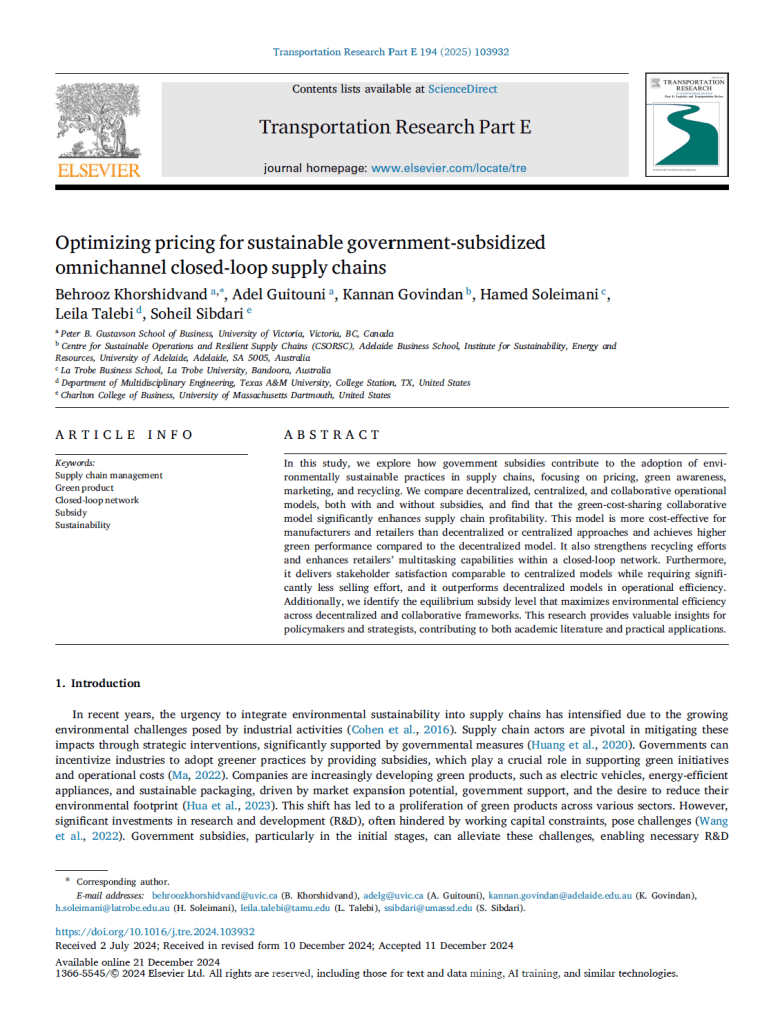
In this study, we explore how government subsidies contribute to the adoption of environmentally sustainable practices in supply chains, focusing on pricing, green awareness, marketing, and recycling. We compare decentralized, centralized, and collaborative operational models, both with and without subsidies, and find that the green-cost-sharing collaborative model significantly enhances supply chain profitability. This model is more cost-effective for manufacturers and retailers than decentralized or centralized approaches and achieves higher green performance compared to the decentralized model. It also strengthens recycling efforts and enhances retailers’ multitasking capabilities within a closed-loop network. Furthermore, it delivers stakeholder satisfaction comparable to centralized models while requiring significantly less selling effort, and it outperforms decentralized models in operational efficiency. Additionally, we identify the equilibrium subsidy level that maximizes environmental efficiency across decentralized and collaborative frameworks. This research provides valuable insights for policymakers and strategists, contributing to both academic literature and practical applications.
 Behrooz Khorshidvand